

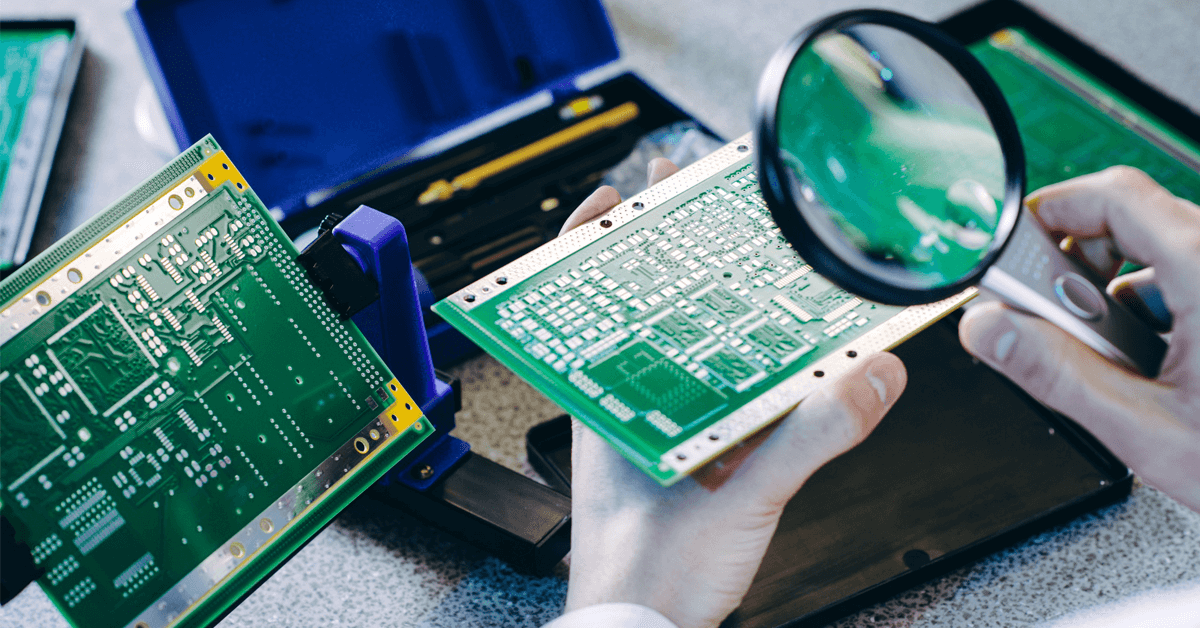
PCB failures can come from various issues, such as process variation, supplier issues, uncontrolled materials, incorrect documentation, or weak corrective actions. Reducing these risks before they result in production delays or recurring problems is the cornerstone of PCB quality assurance.
Understanding PCB Quality Assurance
The terms “quality control assurance” and “quality control” are often confused by manufacturers. However, both terms play a distinct role. To achieve operational consistency, it is vital for ISO- certified companies to institute a quality management system (QMS) that ensures certain requirements. The two most important parts of QMS are quality assurance and quality control.
Quality assurance ensures that vital requirements are met by preventing nonconformances. Throughout the entire quality system including process control, this entails risk-based thinking, planning and continuous improvement efforts. Conversely, quality control focuses on finding nonconformities through various testing, measurement, verification, and inspection actions.
There are many facets of quality assurance, such as implementing procedures and work instructions, traceability and revision, standards compliance, and internal and vendor audits. These standards help ensure that every board that leaves our factory is built to the correct specifications and any issues are identified before they get undermine production or stand in the way a product’s reliability.
PCB Quality Assurance Reduces Process Variation
By setting and monitoring procedures and processes within the quality management system, quality assurance stops nonconforming products at an operation level. These processes and procedures create operational consistency through standardizing how PCBAs are reviewed, handled, released, handled, and fabricated.
Just these actions though, are not enough to ensure success, which is why QA has checks built in. Key performance indicators are one way to monitor progress. For example, a KPI first pass yield shows how many PCBAs meet requirements without re-work. In the event that a declining first pass yield can signal process drift, component problems, or equipment variation. In addition to the first pass yield, EMS also tracks KPIs such as on-time delivery, equipment effectiveness, and re-work rate.
Process variation is reduced through process controls such as equipment calibration, operator training, revision control, and production record review. These processes determine whether the process is repeatable and stable and produces PCBAs that meet industry standards.
QA Improves Material and Documentation Control
The right materials, component lots, and production instructions are key for creating reliable PCBAs. Lowering the risk of using wrong revision or an unapproved part requires component level traceability, incoming checks, and controlled documentation. Because boards may fail due to material issues, substituted components, outdated work instructions, or incomplete production records, material and document control improve PCBA reliability.
Other Benefits
- Quality Control data strengthens the QA system. Inspection and testing are quality control activities, but results serve as vital inputs to quality assurance.
- Standards Lead to Quality Requirements and Repeatable Processes
- Traceability Supports Root-Cause Analysis and Continuous Improvement
Work with Optima Technology Associates for PCB Quality Assurance
We are determined to deliver excellence in every electronics project, whether it is a more complex build or a simple PCB assembly. Our quality management system ensures that we exceed the customers’ expectations while meeting build requirements. We have a controlled production process, component level traceability, and continuous improvement practices.
When you work with Optima Technology Associates, you can be sure that every project is manufactured with great care and detail. If you need a PCB assembler that supports electronic parts for your next build, please feel free to contact us at optima@optimatech.net or by phone number at 717-932-5877.