

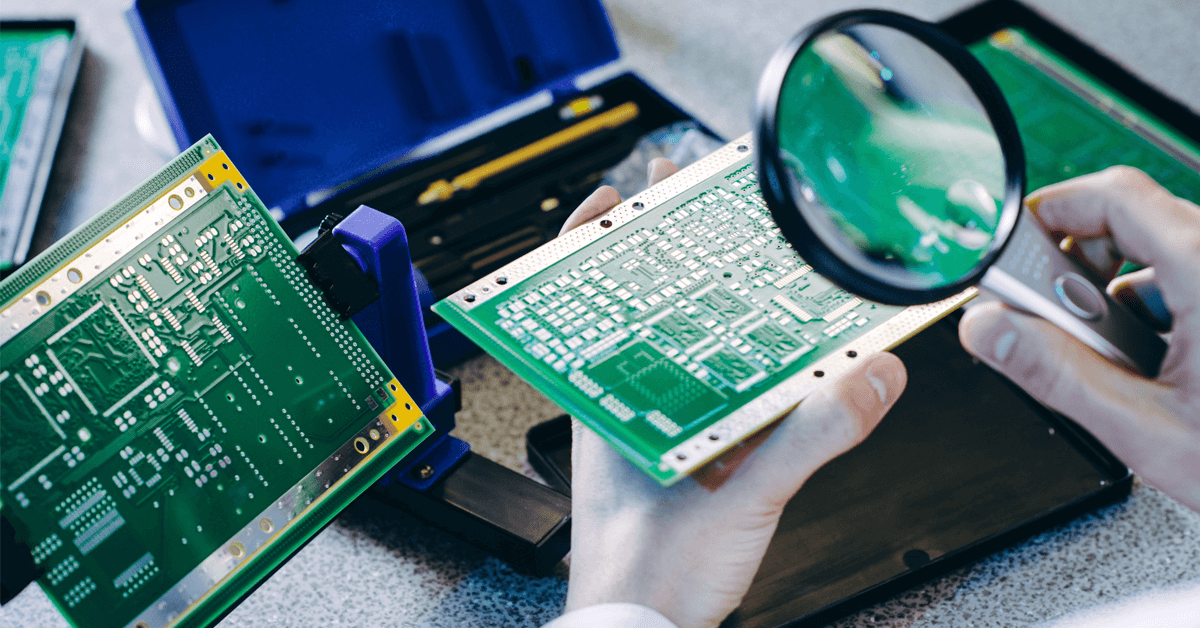
When you consider a printed circuit board (PCB), it’s easy to focus on
- layout,
- components,
- solder mask color.
But what about surface finish? They are the thin protective layers applied over the PCB’s copper features to prevent oxidation and improve solderability thereby enhancing manufacturability and product reliability.
As electronic products become smaller, more complex, and with denser circuitry, choosing the right surface finish has become increasingly more important.
PCB Surface Finishes
Copper is essential to every PCB for conductivity, unfortunately, copper oxidizes easily and once that happens, soldering becomes unpredictable and electrical performance degrades. Various surface finishes can be applied in the PCB manufacturing process to coat exposed copper pads with materials that are more solder‑friendly for assembly. Different metals or coatings, each having their own advantages, disadvantages or limitations , and costs, can be considered based on the final end-use product application..
Common Surface Finishes Include:
- HASL (Hot Air Solder Leveling)
- HASL is one of the most common methods used in PCB manufacturing.
- The board is dipped into molten solder, and then excess solder is blown off using hot air.
- Advantages include:
- Inexpensive
- Readily available
- Provides reliable solderability.
- RoHS compliant, lead-free and leaded options (non-RoHS compliant) are both common.
- The main disadvantage is that the applied coating is not perfectly flat, which can make it more difficult to reliably solder fine‑pitch components.
- ENIG (Electroless Nickel Immersion Gold)
- ENIG has become the common finish for fine‑pitch electronics because the surface is much flatter or smooth than HASL finishes.
- A thin layer of nickel is electrodeposited over the copper to prevent migration of gold into the copper layer, followed by a thin layer of electrodeposited gold.
- Key advantages (particularly for BGA, QFN and other dense component packages)
- Extremely flat, uniform surface,
- excellent corrosion resistance,
- long shelf life
- Disadvantages
- Cost – more expensive than HASL, especially considering the recent escalation of the cost of precious metals
- The plating process must be tightly controlled to prevent defects such as “black pad” from occurring.
- ENEPIG (Electroless Nickel Electroless Palladium Immersion Gold)
- ENEPIG is an enhanced version of ENIG, using a palladium layer between the nickel and the gold.
- Advantages:
- Excellent for wire‑bonding applications
- Better corrosion resistance,
- Less risk of “black‑pad” issues.
- Disadvantage – High cost, so generally used in mission‑critical or high‑performance designs.
- OSP (Organic Solderability Preservative)
- OSP is when a thin organic coating is used to protect exposed copper. The coatings are generally water-soluable.
- Advantages:
- Cost‑effective,
- environmentally friendly,
- flat surface finish
- Disadvantages:
- Durability (i.e. doesn’t stand up to multiple reflow cycles well)
- Shorter shelf life,
- Generally limited to simpler assemblies or high‑volume consumer products.
- Immersion Tin and Immersion Silver
- Both involve simply dipping the PCB into either molten Tin or Silver depending on the end-application.
- Both generally provide flat, well solderable surfaces
- Immersion Tin is commonly used when the assembly includes press-fit connectors. However, when soldered care must be taken to avoid “tin-whiskers.”
- Immersion Silver has very good conductivity and is often used for RF applications, but also must be carefully handled to avoid tarnish (or oxidation).
Choosing the Right Finish
There isn’t one, universal “best” surface finish. The right choice depends on the best combination of design requirements, assembly process, and end-use functional considerations. Commonly though you can consider for:
- High‑density or fine‑pitch designs: ENIG or ENEPIG
- Cost‑sensitive products: HASL or OSP
- Harsh or high‑reliability environments: ENIG or ENEPIG
- RF applications: Immersion silver
- RoHS‑compliant assemblies: Lead‑free HASL, ENIG, ENEPIG, OSP
Selecting the right finish, improves production yield, extends product life, and ensures your PCB assembly performs the way it was designed to.